T R U T O N
The Rational Unified Theory Of Nature
by
Kalman
Klim Brattman
Give
me the simplest form
of matter and
motion,
and I will build,
out of them, the
world of Nature.


"Give
me matter, and I will construct
a world out of it."
Immanuel Kant,
Kant's Cosmology
("Universal
Natural History and Theory Of
Heavens")
1. On
the Impasse of Classical Physics
as Recognized by Werner
Heisenberg and
TRUTON's Response


Throughout the
entire mankind's existence, the
properties of Nature, without
exception, were discovered
through observations and
experiments which were
catalogued and classified in
accordance to certain patterns
that were noted to exist. To
each such pattern discovered,
hypotheses were associated which
were further refined and tested
to determine whether a logical
link could be established among
such hypotheses and whether they
could be reduced to an
underlying common denominator.
Physical theories of Nature were
born out of such intellectual
processes.
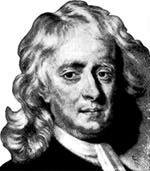
Sir Isaac
Newton, in a letter written in
1672 to Henry Oldenberg, the
Secretary of the Royal Society,
articulated this process of
discovering 'things' in Nature
as follows:
 "For
the best and
safest method of
philosophizing
seems to be, first
diligently to
investigate the
properties of
things and
establish them by
experiment, and
then to seek
hypotheses to
explain them. For
hypotheses ought
to be fitted
merely to explain
the properties of
things and not
attempt to
predetermine them
except in so far
as they can be an
aid to
experiments. If
any one offers
conjectures
about the truth
of things from
the mere
possibility of
hypotheses, I do
not see how
anything certain
can be
determined in
any science; for
it is always
possible to
contrive
hypotheses, one
after another,
which are found
rich in new
tribulations.
Wherefore I judged
that one should
abstain from
considering
hypotheses as from
a fallacious
argument, and that
the force of their
opposition must be
removed, that one
may arrive at a
maturer and more
general
explanation." [Underline
supplied.]
"For
the best and
safest method of
philosophizing
seems to be, first
diligently to
investigate the
properties of
things and
establish them by
experiment, and
then to seek
hypotheses to
explain them. For
hypotheses ought
to be fitted
merely to explain
the properties of
things and not
attempt to
predetermine them
except in so far
as they can be an
aid to
experiments. If
any one offers
conjectures
about the truth
of things from
the mere
possibility of
hypotheses, I do
not see how
anything certain
can be
determined in
any science; for
it is always
possible to
contrive
hypotheses, one
after another,
which are found
rich in new
tribulations.
Wherefore I judged
that one should
abstain from
considering
hypotheses as from
a fallacious
argument, and that
the force of their
opposition must be
removed, that one
may arrive at a
maturer and more
general
explanation." [Underline
supplied.]
Preface
by I. Bernard Cohen
in Isaac Newton's
Opticks (Dover
Publications, Inc.,
1952, pp. xxiv-xxv).
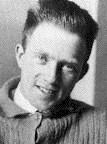
On
Werner Heisenberg's
Observational and
Experimental
Impasse
That inward discovery
method of Physics, from
observations and experiments to
the creation of a theory,
encapsulated so eloquently by
Newton, reached however an
insurmountable impasse when it
arrived at studying the atomic
and subatomic worlds. It was Werner
Heisenberg who first
recognized of an inherent
limitation posed by Classical
Newtonian Physics when one
begins probing the atom and its
structure. The problem, as Heisenberg noted in 1927,
was that when we perform
experiments at the atomic and
subatomic level, regardless how
careful we are, we will
inevitably create and introduce
large
and uncontrollable
perturbations, making
therefore the results and the
data obtained highly unreliable.
In his, now
classic book, "The Physical
Principles of the Quantum
Theory"
(Dover Publications, 1949,
p. 3), Heisenberg made these
critical observations:


"...
[In] classical
physics theories
it has always been
assumed either
that this
interaction is
negligibly small,
or else that its
effect can be
eliminated from
the result by
calculations based
on 'control'
experiments. This
assumption is not
permissible in
atomic physics; the
interaction
between observer
and object
causes
uncontrollable
and large
changes in the
system being
observed.
... The immediate
consequence of
this circumstance
is that in
general every
experiment
performed to
determine some
numerical
quantity renders
the knowledge of
others illusory,
since the
uncontrollable
perturbation of
the observed
system alters
the values of
previously
determined
quantities.
If this
perturbation be
followed in its
quantitative
details, it
appears that in
many cases it is
impossible to
obtain an exact
determination of
the simultaneous
values of two
variables, but
rather that there
is a lower limit
to the accuracy
with which they
can be known."
[Underline
supplied.]
[W.
Heisenberg,
Zeitschrift f�r
Physik, 43, 172,
1927]

That observer
effect (as it is
known today) was further
illustrated by Heisenberg in his
1933 Nobel address and lecture.
There, he most beautifully
illustrated of the imposibility
in studying, through
observations, the "electron-path
concept" by providing a
thought experiment with having
"a microscope of extreme
resolving power."
Attempting to observe "an
electron in its path within an
atom" with that imaginary
high-power microscope,
Heisenberg noted:
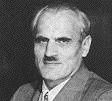
Arthur
Compton
His
experiment of
low-intensity
scattering
of light was
used by
Heisenberg in
his
seminal
argument.
"...
since the specimen
in this microscope
would have to be
illuminated with
light having an
extreme short
wavelength, the
first light
quantum from the
light source to
reach the electron
and pass into the
observer's eye
would eject the
electron
completely from
its path in
accordance with
the laws of the
Compton effect.
Consequently only
one point of the
path would be
observable
experimentally at
any one time."
Werner
Heisenberg: "The
Development of
Quantum Mechanics"
Nobel Lecture,
December 11, 1933,
pp. 291-292.
Paraphrasing
Werner
Heisenberg: "What
we observe is
not Nature
itself, but is
Nature exposed
to our method of
observation!"
Entering
The Dark
.

of
Quantum
Mechanics
.
1. In other words, in
order to be able to see
the electron in that dark, murky
zone, we must need to illuminate
that place with light!
And when we do that and turn on
the light, the traveling
photons of the light
will interact with existing
electrons, perturbing in that
process "big time" the entire
terrain that is being observed.
As such, that big
"uncontrollable perturbation"
created will alter significantly
the studied landscape making
therefore the entire experiment
completely unreliable and thus
worthless.


We
call that monumental
recognition, Heisenberg's
Observational Indeterminacy
Principle (HOIP),
mentioning again that originally,
Heisenberg used the word "ungenauigkeit"
("indeterminacy") to
describe his indeterminate
observational-impasse
(IOI)
recognition that in the
English-language version,
incorrectly, was translated as "uncertainty."
 In fact he was
certain, not uncertain, about
the recognition that at the
atomic level and beyond, the
observational data is no no
longer reliable because of the
inherent uncontrolable
disturbance that is being
created by the observer, as
noted above in his beautiful 1933 Nobel
address and lecture.
In fact he was
certain, not uncertain, about
the recognition that at the
atomic level and beyond, the
observational data is no no
longer reliable because of the
inherent uncontrolable
disturbance that is being
created by the observer, as
noted above in his beautiful 1933 Nobel
address and lecture.
Remarks
on Heisenberg's
Revised
"Indeterminacy"
("Ungenauigkeit")
Principle
 The
Heisenberg's
original HOIP
needs not be
confused with the
totally different
proposition known as
the Heisenberg's
Uncertainty
Principle (HUP)
which proclaims that
the position
and the momentum
of a particle cannot
be precisely
determined
simultaneously
because of the
particle's wave-like
nature.
The
Heisenberg's
original HOIP
needs not be
confused with the
totally different
proposition known as
the Heisenberg's
Uncertainty
Principle (HUP)
which proclaims that
the position
and the momentum
of a particle cannot
be precisely
determined
simultaneously
because of the
particle's wave-like
nature.
According
to HUP,
the more precisely
the position of
a particle could be
determined to be,
the less precisely
its momentum
could be obtained,
and vice versa. That
"catch me if you
can"
position-momentum
play is not an
exclusive play
performed at the
nano level of
Nature.
 A
butterfly, for
instnce, is designed
to perform the same
play as described in
HUP!
Indeed,
when the butterfly
stay still, with
ease we can
determine its
exact position.
However, as the
butterfly begin to
fly, its erratic
motion will create
a challenge to
keep up
determining its
position and that
challenge
increases
significantly with
the increase of
its speed. So the
correlation
between speed and position become apparent: the greater
the speed, the
more difficult was
to determine its
exact position.
A
butterfly, for
instnce, is designed
to perform the same
play as described in
HUP!
Indeed,
when the butterfly
stay still, with
ease we can
determine its
exact position.
However, as the
butterfly begin to
fly, its erratic
motion will create
a challenge to
keep up
determining its
position and that
challenge
increases
significantly with
the increase of
its speed. So the
correlation
between speed and position become apparent: the greater
the speed, the
more difficult was
to determine its
exact position.
 Let's stress again
that the principle
of HUP has
nothing to do with
the indeterminate
observational
impasse (IOI) caused by the observer's inherent
intrusion (due to
the "large
and
uncontrollable
perturbations"
created within the
system by the
viewer's act of
observation as
brilliantly noted by
Heisenberg),
but is about the
proclamation of the
vagueness of the
wave-like nature of
matter.
Let's stress again
that the principle
of HUP has
nothing to do with
the indeterminate
observational
impasse (IOI) caused by the observer's inherent
intrusion (due to
the "large
and
uncontrollable
perturbations"
created within the
system by the
viewer's act of
observation as
brilliantly noted by
Heisenberg),
but is about the
proclamation of the
vagueness of the
wave-like nature of
matter.
As
such, through that
scenario of HUP,
irrespective of the
viewer's
observational
intrusion, the
uncertainty of the
measurements must
occur because of the
inherent wave-like
characteristic of
the matter itself.
 So
far, so good! So far
everything is
correct as the
wave-like
characteristic of
the electrons and
protons is firmly
established by us in
our page 10.
Thus, because of
that inherent murky
wave-like
charactheristic of
matter, we should
not expect to get
exact deterministic
results. Because of
that limited
uncertainty, the Mathematical
Theory of
Probabilty (MATOP)
will play a
pivotal role.
So
far, so good! So far
everything is
correct as the
wave-like
characteristic of
the electrons and
protons is firmly
established by us in
our page 10.
Thus, because of
that inherent murky
wave-like
charactheristic of
matter, we should
not expect to get
exact deterministic
results. Because of
that limited
uncertainty, the Mathematical
Theory of
Probabilty (MATOP)
will play a
pivotal role.
Two distinct
principles began to
emerge HOIP
and HUP
that now needs our
attention and review.
<I> HOIP leads now to
the recognition of the existence
of an Ultimate
Bottom Observational Frontier
(UBOF) of Nature that
is encapsulated into


The First
Foundational
Universal
Recognition Of
Nature
(1st
FURON)
There
is an Ultimate
Bottom
Observational
Frontier (UBOF)
beyond which,
Nature is no
longer
accurately
observable.
 Nature, at its
nano-scale base
structure, as
first recognized
by Werner
Heisenberg,
cannot be
observed without
modifying or
altering in a
significant way
its existing
natural
settings.
Nature, at its
nano-scale base
structure, as
first recognized
by Werner
Heisenberg,
cannot be
observed without
modifying or
altering in a
significant way
its existing
natural
settings.
.That
is to say that the
true, accurate
picture of Nature,
at its nano-scale,
cannot be obtained
through any
observational
probe because,
through
illumination, we
are interfering
and destroying the
original existing
settings.
.Indeed,
upon attempting to
"see" that
bottom-level
landscape of
Nature, we
invariably need
illumination which
in turn requires
turning on the
light. And by
introducing light
into the system,
that, in itself,
will change,
through
interaction, in a
dramatic fashion
the entire existed
configuration that
is being studied.
.Thus,
the inherent
process of
illumination, and
nothing else, is
the culprit of
that inherent
distortion of the
reality governing
the nano-structure
of Nature. Without
the illumination,
we need therefore
finding a new way
of "seeing" Nature
at its nano-base
ultimate level of
existence, and
that new way can
be provided by
TRUTON!
.
Fundamental Corollary of Classical
Physics
Limitation:
By the 1st FURON, it follows that the methods of Classical Physics in
obtaining its
results can no
longer be
extended
beyond UBOF.
 Remark: From
Heisenberg's
HOIP, the future of
Experimental Particle Physics
(EPP) could have been put
to an abrupt end --something
that no one could have accepted.
As such, in a hurry the same
Heisenberg came to the rescue in
saving the gloomy predicament.
Remark: From
Heisenberg's
HOIP, the future of
Experimental Particle Physics
(EPP) could have been put
to an abrupt end --something
that no one could have accepted.
As such, in a hurry the same
Heisenberg came to the rescue in
saving the gloomy predicament.
<II>
 To keep alive Experimental
Particle Physics (EPP),
Heisenberg's Uncertainy
Principle (HUP)
was born. Now "uncertainty" was
no longer due to the observer
injecting into the system large
and uncontrolable perturbations
due to the illumination for
viewing, but it was because of
the wave-like characteristics of
the system itself.
To keep alive Experimental
Particle Physics (EPP),
Heisenberg's Uncertainy
Principle (HUP)
was born. Now "uncertainty" was
no longer due to the observer
injecting into the system large
and uncontrolable perturbations
due to the illumination for
viewing, but it was because of
the wave-like characteristics of
the system itself.
To cement
further his HUP,
Heisenberg got much inspiration
from Einstein's lunatic Special
Relativity (SR) theory as
expanded below.
On the Birth
of Quantum
Mechanics through
Heisenberg's
Uncertainty
Principle
and
Its Connection to
Einstein's Special
Theory of
Relativity
 That
profound recognition of
Heisenberg that Classical
Physics (Claphy), through
its existing inductive method,
was not able to probe Nature at
its atomic and nuclear level as
noted in the 1st FURON, posed a
formidable challenge for the
direction of Physics. A rational
person, in a normal state of
mind, would have concluded that
experiments designed of probing
Nature at its atomic and
subatomic levels are useless
because the data obtained are
highly corrupted and
uncontrollable. But such a
scenario --dictated by
Heisenberg's
Observational
Indeterminacy Principle (HOIP) was not
something that could be accepted
for the future of Atomic
Physics. As such, something else
had to be implanted.
That
profound recognition of
Heisenberg that Classical
Physics (Claphy), through
its existing inductive method,
was not able to probe Nature at
its atomic and nuclear level as
noted in the 1st FURON, posed a
formidable challenge for the
direction of Physics. A rational
person, in a normal state of
mind, would have concluded that
experiments designed of probing
Nature at its atomic and
subatomic levels are useless
because the data obtained are
highly corrupted and
uncontrollable. But such a
scenario --dictated by
Heisenberg's
Observational
Indeterminacy Principle (HOIP) was not
something that could be accepted
for the future of Atomic
Physics. As such, something else
had to be implanted.
 Well, with no
other alternative available to
be pursued, a radically new
approach was coined by
Heisenberg to be the solution
were logic and rationality need
no longer needed to reign
supreme as the irrationality
--under certain circumstances--
was quite useful and thus
allowed to enter into the realm
of the "new"
Physics to be called
now the "modern"
Physics (Mophy) to be
differentiated from "classical"
Physics (Claphy) were no such
impurities of logic were allowed
to exist.
Well, with no
other alternative available to
be pursued, a radically new
approach was coined by
Heisenberg to be the solution
were logic and rationality need
no longer needed to reign
supreme as the irrationality
--under certain circumstances--
was quite useful and thus
allowed to enter into the realm
of the "new"
Physics to be called
now the "modern"
Physics (Mophy) to be
differentiated from "classical"
Physics (Claphy) were no such
impurities of logic were allowed
to exist.

 Einstein's
lunatic Special Theory of
Relativity (STR) suddenly become
extremely appealing to
Heisenberg not because of its
results that were meaningless
and unusable in Heisenberg's
Quantum Mechanics, but because
of the irrational modality that
those results were obtained.
Particularly, Heisenberg has
been impressed with the fact
that Einstein's theory of
relativity (which had gained
some momentum for its general
acceptance) was based on an
approach incorporating those
two (2) novel
characteristics:
Einstein's
lunatic Special Theory of
Relativity (STR) suddenly become
extremely appealing to
Heisenberg not because of its
results that were meaningless
and unusable in Heisenberg's
Quantum Mechanics, but because
of the irrational modality that
those results were obtained.
Particularly, Heisenberg has
been impressed with the fact
that Einstein's theory of
relativity (which had gained
some momentum for its general
acceptance) was based on an
approach incorporating those
two (2) novel
characteristics:
.i)

 that
when needed,
willy-nilly
hypotheses can be
created in a hurry,
with no immediate
rationale for their
existence, to
justify the
incorporation of
certain
predetermined
results (such as
that the speed light
is the maximum speed
attainable in the
Universe), and place
them --ad hoc--
at the top of the
theory, claiming to
represent
fundamental and
universal "laws of
Nature" and,
that
when needed,
willy-nilly
hypotheses can be
created in a hurry,
with no immediate
rationale for their
existence, to
justify the
incorporation of
certain
predetermined
results (such as
that the speed light
is the maximum speed
attainable in the
Universe), and place
them --ad hoc--
at the top of the
theory, claiming to
represent
fundamental and
universal "laws of
Nature" and,
.ii)
 that
when in an impasse
and difficulty to
find a coherent
picture and theory
of Nature, we can
always find refuge
in blaming our Mind
for its "biological"
inadequacy in not
being able to grasp
Nature at its most
fundamental levels
of existence on the
grounds that our
Mind and Brain
biologically evolved
only to deal with
"things" derived
from our everyday
experience.
that
when in an impasse
and difficulty to
find a coherent
picture and theory
of Nature, we can
always find refuge
in blaming our Mind
for its "biological"
inadequacy in not
being able to grasp
Nature at its most
fundamental levels
of existence on the
grounds that our
Mind and Brain
biologically evolved
only to deal with
"things" derived
from our everyday
experience.
 Accordingly, by
that incredulous
reasoning, when
dealing with matters
outside our everyday
experience, the Mind
--through its
purported biological
limitations-- is not
able to render
coherent
descriptions of
Nature or form a
coherent mental
picture, and thus it
is perfectly
acceptable, as a
matter of necessity,
to introduce
irrationalities and
incoherencies into
such descriptions
and theories of
Nature.
Accordingly, by
that incredulous
reasoning, when
dealing with matters
outside our everyday
experience, the Mind
--through its
purported biological
limitations-- is not
able to render
coherent
descriptions of
Nature or form a
coherent mental
picture, and thus it
is perfectly
acceptable, as a
matter of necessity,
to introduce
irrationalities and
incoherencies into
such descriptions
and theories of
Nature.
!
Tell that cockamamie to a mathematician that our current cultivated Mind cannot render logical
inferences
outside the
world of which
we have no
experience and
which we
cannot observe
and see, for
yourself, the
answer that
you may get
after the
insanity is
being ruled
out!
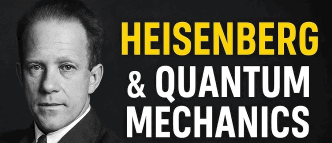 Heisenberg saw that approach
pioneered by Einstein as the
ticket to the solution for his
problem. Following Einstein,
Heisenberg transformed his
stunning Observational
Indeterminacy Principle (HOIP) into a new
Principle, called the Uncertainty
Principle (HUP)
that has had now nothing to do
with observations! Now, the
biological limitation of the
Mind has been blamed! Asides
from the described
possition-momentum (catch me if
you can) saga, the Mind --by its
purported biological
limitation-- was viewed as the
real culpit [sic!]. That
incredulous proposition was
needed for the necessity of
introducing into his quantum
theory an incoherent language
for expressing and describing
phenomena at the atomic and
subatomic levels. In several
places of his quoted book, Heisenberg
articulated all these points as
follows.
Heisenberg saw that approach
pioneered by Einstein as the
ticket to the solution for his
problem. Following Einstein,
Heisenberg transformed his
stunning Observational
Indeterminacy Principle (HOIP) into a new
Principle, called the Uncertainty
Principle (HUP)
that has had now nothing to do
with observations! Now, the
biological limitation of the
Mind has been blamed! Asides
from the described
possition-momentum (catch me if
you can) saga, the Mind --by its
purported biological
limitation-- was viewed as the
real culpit [sic!]. That
incredulous proposition was
needed for the necessity of
introducing into his quantum
theory an incoherent language
for expressing and describing
phenomena at the atomic and
subatomic levels. In several
places of his quoted book, Heisenberg
articulated all these points as
follows.
<1> In his
Introductory chapter (ibid., pp. 3-4),
Heisenberg noted:
"The
starting-point of
the critique of the
relativity theory
was the postulate
that there is no
signal velocity
greater than that of
light. In
a similar manner,
this lower limit
to the accuracy
with which certain
variables can be
known
simultaneously may
be postulated as a
law of Nature (in
the form of the
so-called
uncertainty
relations) and
made the
starting-point of
the critique which
forms the subject
matter of the
following pages. These
uncertainty
relations gives us
that measure of
freedom from the
limitations of
classical concepts
which is necessary
for a consistent
description of
atomic processes." [Underline
supplied.]
<2> The linkage in
approach to Einstein's
relativity theory was essential
for Heisenberg to justify and
consolidate his own position as
he noted of this (ibid., p. 62):
"With
the advent of
Einstein's
relativity theory it
was necessary for
the first time to
recognize that the
physical world
differed from the
ideal world
conceived in terms
of everyday
experience."
<3> Then, with this
linkage to Einstein's relativity
theory being established,
Heisenberg went for his desired
setup alluding to the
inadequacies of the Mind when
dealing with profound concepts
of Nature such as the one posed
by the relativity theory ((ibid., p. 62):
... but
as the mind is
always slow to
adjust itself to
an extended range
of experience and
concepts,
the theory of
relativity seemed at
first repellently
abstract.
Nonetheless, the
simplicity of its
solution for a
vexatious problem
has gained it
universal
acceptance. As is
clear from what has
been said, the
resolution of the
paradoxes of
atomic physics can
be accomplished
only by further
renunciation of
old and cherished
ideas.
Most important of
these is the idea
that natural
phenomena obey exact
laws --the principle
of causality." [Underline
supplied.]
<4> Now with that
setup being in place, Heisenberg
went in full force for the kill,
attacking mercilessly the
Language provided and developed
by the Mind as being wholly
inadequate when dealing with the
atomic world (ibid., p. 11):
"It
is not surprising
that our language
should be incapable
of describing the
processes occurring
within the atoms,
for, as has been
remarked, it was
invented to describe
the experiences of
daily life, and
these consist only
of processes
involving
exceedingly large
numbers of atoms.
Furthermore, it is
very difficult to
modify our language
so that it will be
able to describe
these atomic
processes, for words
can only describe
things of which we
can form mental
pictures, and this
ability, too, is the
result of daily
experience.
Fortunately,
mathematics is not
subject to this
limitation, and it
has been possible to
invent a
mathematical scheme
--the quantum
theory-- which seems
entirely adequate
for the treatment of
atomic processes;
for visualization,
however, we must
content ourselves
with two incomplete
analogies --the wave
picture and the
corpuscular
picture."
<5> Pondering over
that nagging "schizophrenic"
representation vested in the
duality particle-wave picture,
Heisenberg blamed this situation
on Language as well! (ibid., p. 10):
"Light
and matter are both
single entities, and
the apparent duality
arises in the
limitations of our
language." [sic!]
With this everything was set, in
terms of justification and
explanation, to proceed
embarking into a new theoretical
world pioneered by Einstein,
where anything conforming to a
willy-nilly mathematical scheme
can be accepted as a theory of
the atomic and subatomic world
regardless of whether or not the
results obtained have any
meaning, sense, or any physical
rationality for their existence.
The
mathematical scheme and not
the Physics was what counted
in this description. The fact that
this description, from time to
time, as needed, would stray
away from logic, coherence,
common sense, or rational
intuition and rational thinking
was perfectly acceptable due to
the limitations of the Mind and
Language which were so zealously
professed to exist. Since no
formal constraints existed in
this new theoretical world
anything could have been added
to the existing "mathematical
scheme" until we could reach
"explaining" the desired result.
<6> Thus,
Heisenberg's initial uncertainty
principle based on the
recognition that all
experimental data at the atomic
and subatomic level carry
"uncontrollable large
uncertainties" let him transform
this recognition into a vehicle
for transporting us into a new
world free from the constraints
and limitations that Logic,
Common Sense Intuition, and
Rational Thinking would provide
--a world called the quantum
mechanics world. And
Heisenberg noted of the
blessings that this new found
world could provide were his
Uncertainty Principle was able
to be incorporated as one of its
pillars (ibid., p. 4):
"These
uncertainty
relations gives us
that measure of
freedom from the
limitations of
classical concepts
which is necessary
for a consistent
description of
atomic processes."
Sadly, the only "consistency" in
the descriptions provided in
this new quantum mechanics world
was that there, those
descriptions no longer needed to
have any physical meaning
associated with them and, that
they could be expressed into a
Language that defies our common
sense and rationality. Yes,
there, in that world, we can
enjoy --for whatever it is
worth-- an absolute "freedom
from the limitations of
classical concepts."
<7> Now, that
Einstein's relativity theory had
served its purpose for setting
up a new irrational framework
for the theoretical studies at
the atomic and subatomic level,
Heisenberg saw no need to be
tied up anymore with that
Einstein's theory which could no
longer be used in any other way.
For Heisenberg it was time to
move on, not before however
dismantling one of Einstein's
most sacred physical principles
of Nature embodied in the law
of causality and
formalized first by Isaac Newton
in his seminal Principia.
Heisenberg made note for the
necessity of such a move in his
Introductory chapter of his
referenced quantum theory book (ibid., p. 2):
"Although
the theory of
relativity makes the
greatest of demands
on the ability for
abstract thought,
still it fulfills
the traditional
requirements of
science in so far as
it permits a
division of the
world into subject
and object (observer
and observed) and
hence a clear
formulation of the
law of causality.
This is the very
point at which the
difficulties of the
quantum theory
begin."
Let us then take a closer look
at this dramatic departure from
both Classical Physics and
Einstein's relativity theory
which Heisenberg had advocated
to be necessary to take place in
order to "understand" the atomic
and subatomic worlds.

On the Forced
Abandonment of
Casuality in
Quantum Mechanics
Theory as Initiated
by Heisenberg
 From
Heisenberg's briliant
recognition formalized in his Observational
Indeterminancy Principle (HOIP),
it follows that by
not being able the predict the
outcome of an experimental
result at the atomic or
subatomic level, we no longer
can talk now, in a meaningful
way, about a cause-effect
relationship (CER). To
correct that undesirable
situation, Heisenberg covered
his briliant obervational
recognition of HOIP
to a new Uncertainty
Principle (HUP)
that blames now the Mind for the
murky situation created!
Casuality was no longer part of
any consideration.
From
Heisenberg's briliant
recognition formalized in his Observational
Indeterminancy Principle (HOIP),
it follows that by
not being able the predict the
outcome of an experimental
result at the atomic or
subatomic level, we no longer
can talk now, in a meaningful
way, about a cause-effect
relationship (CER). To
correct that undesirable
situation, Heisenberg covered
his briliant obervational
recognition of HOIP
to a new Uncertainty
Principle (HUP)
that blames now the Mind for the
murky situation created!
Casuality was no longer part of
any consideration.
Let's note that
Heisenberg was absolutely
correct that from HOIP,
we cannot reach a cause-effect
(CER) as he so
briliantly noted that in his
Nobel Prize lecture and futher
elaborated in his cited book (ibid., pp. 62-64):
"...
our ordinary
description of
Nature, and the idea
of exact laws, rests
on the assumption
that it is possible
to observe the
phenomena without
appreciably
influencing them. To
coordinate a
definite cause to
a definite effect
has sense only
when both can be
observed without
introducing a
foreign element
disturbing their
interrelation.
The law of
causality, because
of its very nature,
can only be defined
for isolated
systems, and in
atomic physics even
approximately
isolated systems
cannot be observed.
This might have been
foreseen, for in
atomic physics we
are dealing with
entities that are
(so far as we know)
ultimate and
indivisible. There
exist no
infinitesimals by
the aid of which an
observation might be
made without
appreciable
perturbation.
Second
among the
requirements
traditionally
imposed on a
physical theory is
that it must explain
all phenomena as
relations between
objects existing in
space and time. This
requirement has
suffered relaxation
in the course of the
development of
physics. ... Now,
as a geometric or
kinematic
description of a
process implies
observation, it
follows that such
a description of
atomic processes
necessarily
precludes the
exact validity of
the law of
causality --and
conversely.
Bohr
has pointed out that
it is therefore
impossible to demand
that both
requirements be
fulfilled by the
quantum theory. They
represent
complementary and
mutually exclusive
aspects of atomic
phenomena. ... This
indeterminateness of
the picture of the
process is a direct
result of the
indeterminateness of
the concept
'observation' --it
is not possible to
decide, other than
arbitrarily, what
objects are to be
considered as part
of the observed
system and what as
the observer's
apparatus. ...
Even when this
arbitrariness is
taken into account
the concept
'observation'
belongs, strictly
speaking, to the
class of ideas
borrowed from the
experiences of
everyday life. It
can only be carried
over to atomic
phenomena when due
regard is paid to
the limitations
placed on all
space-time
descriptions by the
uncertainty
principle." [Underline
supplied.]

Remarks on the cause-effect
pillar:
You see, Nature could care less
whether or not we can keep up with
the complexities of its behavior.
Just because we cannot predict,
with our forecasting method, when
and where exactly rain will occur
on Earth this does not mean that
in fact rain will not occur
exactly when and where the
conditions for the rain are met.
That distinction
is paramount and it can never be
blurred away. To bypass and
override that distinction,
Heisenberg, as we have seen
above, has elevated --with no
rationality or any sort of
justification-- his Uncertainty
Principle (HUP)
to the ultimate status, by
postulating it, to be a "law of
Nature."
 But that
approach clearly cannot be
supported for a rational theory
of Nature. And that is because
But that
approach clearly cannot be
supported for a rational theory
of Nature. And that is because
the deterministic cause-effect
is always present in Nature
regardless of our abilities of
being able to predict it or
not, regardless of whether we
have observed it or not,
regardless of whether we exist
or not! If the input is the
cause and the output is the
effect, then in Nature always
to each input will correspond
a determined and precise
output.
The input can be
a sum of many individual
'actions' acting simultaneously
which could be independent or
dependent (linearly or
non-linearly) from each other,
and the output of this is the
cumulative superimposed effect
or 'reaction' obtained which
always manifests its existence
in a deterministic way whether
we can predict it or not.
With that
language and terminology
employed, we have that
to a superimposed cumulative
action always a deterministic
reaction will correspond which
will manifest its existence in
a precise and well-defined
way.
But
that realization, on a further
reflection, is in fact a
generalization of Newton's Third
Law of Motion which states that
to every (linear) action there
is always opposed an equal
(linear) reaction.
 The existence of
a reaction to every action is
due to the fact that the
reaction is nothing more, nor less, than the
concrete expression of a real
relationship that the
action has established with
its surrounding environment.
The existence of
a reaction to every action is
due to the fact that the
reaction is nothing more, nor less, than the
concrete expression of a real
relationship that the
action has established with
its surrounding environment.
 It is of
paramount importance to further
recognize, beyond a shadow of
doubt, the following:
It is of
paramount importance to further
recognize, beyond a shadow of
doubt, the following:
1)
That
there is no distinction
between how Nature operates at
large scale (the macro cosmos)
or at the most minute scale
(the micro cosmos).
And
that is because there is one, and only one, logic upon
which the entire Universe
"functions." If that would not
have been the case, then an
internal self-conflict would
have developed resulting in the
inability of the Universe to
exist, as a unit, and thus of
the Universe's inability to
exist at all. And second,
2) That the
logic upon which the
Universe "functions" is one
and the same with the logic
upon which our Mind is
"equipped to function" as illustrated
through countless of examples
that can be provided from our
everyday experience.
To recapitulate,
there is one and only one
universal principle of operation
in Nature:
 to each
real, physical cause
it corresponds a
real, well-defined
physical effect
which is the real
form of
manifestation and
expression of the
cause's existence.
The effect is always
the real
manifestation of the
relationship
that the cause has
established with its
environmental
medium. Depending on
the initial
conditions, that relationship can
be a simple or a
complex one, but
always a
deterministic one.
to each
real, physical cause
it corresponds a
real, well-defined
physical effect
which is the real
form of
manifestation and
expression of the
cause's existence.
The effect is always
the real
manifestation of the
relationship
that the cause has
established with its
environmental
medium. Depending on
the initial
conditions, that relationship can
be a simple or a
complex one, but
always a
deterministic one.

Let us conclude with this Part
by noting that if Heisenberg's
Uncertainty Principle (HUP) was truly a
principle of Nature governing
the atomic and subatomic
systems, then we, for instance,
would never could have been able
to build an atomic bomb or use
atomic energy in any
deterministic and precise way!
No,
Nature does not employ or
function on uncertain terms
or uncertain principles.
 The only
uncertainties that we can
associate to a phenomenon of
Nature are our own predictions
derived from our particular
method of forecasting. But that
is, of course, an entirely
different thing, for crying out
loud.
The only
uncertainties that we can
associate to a phenomenon of
Nature are our own predictions
derived from our particular
method of forecasting. But that
is, of course, an entirely
different thing, for crying out
loud.
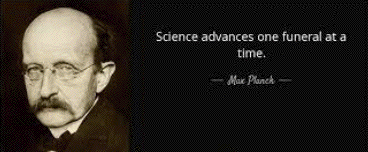
" Science
advances one
funeral at a
time." Max
Planck
On the Demise of
Quantum Mechanics:
Rejecting
the Negation of
Causality in a
Theory of Nature
 No rational
theory of Nature can be based on
a foundational pillar
proclaiming that to a defined
physical cause there will not
necessarily correspond a
deterministic effect, as that
contradicts, in a fundamental
way, our way of thinking, our
way of drawing inferences. Our
evolved cultivated Mind will not
allow for such an inference to
take place. Just because we
cannot predict in a
deterministic way the effect
resulted from a cause OR that we cannot
even "see" the respective
effect, this does not mean that
a deterministic effect does not
in fact exist. As we have seen
from the presentation given
above, it is a fundamental
recognition that in Nature to
each action always will
correspond a reaction which
will manifest its existence,
in a deterministic way, either
directly or indirectly.
No rational
theory of Nature can be based on
a foundational pillar
proclaiming that to a defined
physical cause there will not
necessarily correspond a
deterministic effect, as that
contradicts, in a fundamental
way, our way of thinking, our
way of drawing inferences. Our
evolved cultivated Mind will not
allow for such an inference to
take place. Just because we
cannot predict in a
deterministic way the effect
resulted from a cause OR that we cannot
even "see" the respective
effect, this does not mean that
a deterministic effect does not
in fact exist. As we have seen
from the presentation given
above, it is a fundamental
recognition that in Nature to
each action always will
correspond a reaction which
will manifest its existence,
in a deterministic way, either
directly or indirectly.
 Any theory
purporting to be a theory of
Nature which does not subscribe
to that fundamental principle,
is a theory, par excellence, of
the Absurd. That is why Quantum
Mechanics is par excellence a mechanics
of the absurd (MOA).
Any theory
purporting to be a theory of
Nature which does not subscribe
to that fundamental principle,
is a theory, par excellence, of
the Absurd. That is why Quantum
Mechanics is par excellence a mechanics
of the absurd (MOA).
 Quantum
Mechanics theory, having as its
foundational pillar a negation
of that fundamental principle of
Nature through Heisenberg's
Uncertainty Principle, is an
example, of such "par
excellence" mechanics of
the Absurd (MOA). It is
imperative that Quantum
Mechanics theory, which is
disguised under the coat of
advanced Mathematics, no longer
be permitted to represent the
atomic and subatomic theory of
Nature and be exposed for what
it stands for, for what it is,
and for what it is purported to
be.
Quantum
Mechanics theory, having as its
foundational pillar a negation
of that fundamental principle of
Nature through Heisenberg's
Uncertainty Principle, is an
example, of such "par
excellence" mechanics of
the Absurd (MOA). It is
imperative that Quantum
Mechanics theory, which is
disguised under the coat of
advanced Mathematics, no longer
be permitted to represent the
atomic and subatomic theory of
Nature and be exposed for what
it stands for, for what it is,
and for what it is purported to
be.
Nobel Laureate
Gerard 't Hooft:
 An
intellectual standing
against Quantum Mechanics
theory must be made, as the
negation of causuality in a
theory of Nature is not
acceptable under any
scenario.
An
intellectual standing
against Quantum Mechanics
theory must be made, as the
negation of causuality in a
theory of Nature is not
acceptable under any
scenario.
 Another
staggering consequence that
immediately follows from Heisenberg's
Uncertainty Principle (HUP),
when elevated as a fundamental
law of Nature (FLON),
is that a particle, at the same
time, can be in two (2)
different places!
Another
staggering consequence that
immediately follows from Heisenberg's
Uncertainty Principle (HUP),
when elevated as a fundamental
law of Nature (FLON),
is that a particle, at the same
time, can be in two (2)
different places!
 That
absurdity, which offends
the Mind in a direct flagrant
way, was needed to be accepted
since according to the
proponents of Quantum Mechanics
theory, there, at the atomic and
subatomic level, Nature is
governed by different rules
which may appear to the Mind as
inconsistencies of logic
(IOLs).
That
absurdity, which offends
the Mind in a direct flagrant
way, was needed to be accepted
since according to the
proponents of Quantum Mechanics
theory, there, at the atomic and
subatomic level, Nature is
governed by different rules
which may appear to the Mind as
inconsistencies of logic
(IOLs).
P. A. M.
Dirac, another founder of
Quantum Mechanics theory
articulated this very point in
the Preface of his classic book
The Principles of Quantum
Mechanics (Fourth Edition,
Oxford Press, 1958, pp.
vii-viii) as follows:
"It
has become
increasingly evident
in recent times,
however, that Nature
works on a different
plan [sic!].
Her fundamental laws
do not govern the
world as it appears
in our mental
picture in any very
direct way, but
instead they control
a substratum of
which we cannot form
a mental picture
without introducing
irrelevancies." [Underline
supplied.]
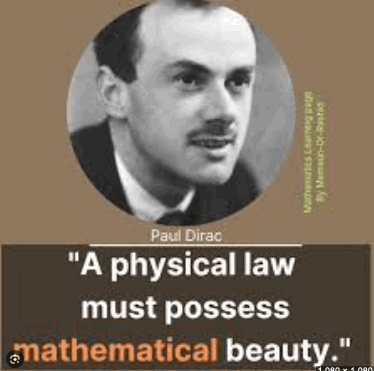
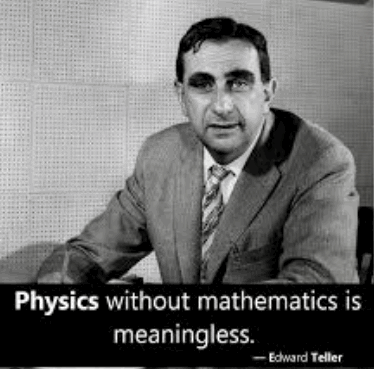
 Dirac's
proclamation that Mathematics
should dictate
Physics,
should never ever
happen:
Dirac's
proclamation that Mathematics
should dictate
Physics,
should never ever
happen:
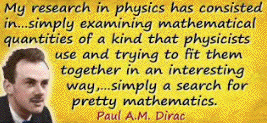

...
as the seduction and
addiction towards the
beauty and elegance of
Mathematics is now
total, regardless of
its foundational
structure...
 ,,,
,,, 
PS>
There
are a number
floating jokes
around, for a
number of decades,
of how
mathematicians
view physicists
that use solely
Mathematics for
their theoretical
work:
One such a joke is
this: "Physicists
are just failed
mathematicians."
(Implying that if
they were rigorous
enough, they'd be
doing pure
math...)

 Among other common quips that are circulating around on
the difference
between a
mathematician
and a theoretical
physicist,
we note these
ones:
Among other common quips that are circulating around on
the difference
between a
mathematician
and a theoretical
physicist,
we note these
ones:
- Mathematicians
sometimes joke
that
theoretical
physicists are
just using
math "on loan"
without
learning the
grammar...
like
tourists
yelling
confidently in
a foreign
country...
- The
difference
between a
mathematician
and a
theoretical
physicist is
that:
the
mathematician
wants to be
the first to
prove the
theorem; the
physicist
wants to be
the first to
build a
universe out
of it!
- To a
mathematician,
a 'proof' must
be logically
flawless.
To a
theoretical
physicist,
'proof' means
'the
calculation
produced a
number that
matched the
experiment'.
[sic!]
 That
absolute nonsense, which has
been embraced almost blindly, as
an act of some faith, by those
who preach Quantum Mechanics
theory, as representing a principle
of Nature (PON), cannot be
left unexposed as it represents
the greatest impediment to a
true theory of Nature describing
the atomic and subatomic level.
That
absolute nonsense, which has
been embraced almost blindly, as
an act of some faith, by those
who preach Quantum Mechanics
theory, as representing a principle
of Nature (PON), cannot be
left unexposed as it represents
the greatest impediment to a
true theory of Nature describing
the atomic and subatomic level.
It bears
repeating and repeating, again
and again, that there is one,
and only one, logic upon which
the Universe "functions" since
if this would not been the
case, then an internal
"functional" conflict would
have had emerged making it
impossible for the Universe to
exist as a unit. And that
logic, upon which the Universe
"functions," is identical with
the logic upon which the Mind
"functions," as illustrated
through countless examples
derived from our everyday
experience.



Because of that unity in logic,
for the Nature's modus
operandi, that we
recognize to exist, we are
striving to find a true
rational unified theory of
Nature (TRUTON). It is
because of that recognition,
that the Quantum Mechanics
theory must be expunged, as
being utterly repugnant, at its
very core of existence. The
so-called quantum logic
(quantogic) is par
excellence an example of a
logic of the irrational reaching
the level of the Absurd (Absurdogic).
 Following
that quantogic, we immediately
can recognize its fallacy. For
instance, following that quantum
logic, we can now talk say, of a
table being in two (2)
distinct places at the same
time! That very point, of the
absurdity of such type of
results, was articulated, for
instance, by Sir Roger
Penrose of
Oxford University in England, in
an interview with The New
York Times, as follows:
Following
that quantogic, we immediately
can recognize its fallacy. For
instance, following that quantum
logic, we can now talk say, of a
table being in two (2)
distinct places at the same
time! That very point, of the
absurdity of such type of
results, was articulated, for
instance, by Sir Roger
Penrose of
Oxford University in England, in
an interview with The New
York Times, as follows:
 "I
can think of a[t]
least one major
area, which I'm
absolutely sure is
missing from the
present-day physics,
which probably will
come in the next 50
years or so, and it
will be a tremendous
revolution. It has
to do with how to
understand quantum
mechanics. See,
quantum mechanics
describes
small-scale
phenomena -- atoms,
molecules,
particles. And if
you have certain
rules, which if you
try to apply them to
large objects, they
give you nonsense.
They will tell you
that a baseball can
be here and there at
the same time. There
are endless ways
that people try to
argue around this.
But to me, it says
that the theory is
just not right..."
"I
can think of a[t]
least one major
area, which I'm
absolutely sure is
missing from the
present-day physics,
which probably will
come in the next 50
years or so, and it
will be a tremendous
revolution. It has
to do with how to
understand quantum
mechanics. See,
quantum mechanics
describes
small-scale
phenomena -- atoms,
molecules,
particles. And if
you have certain
rules, which if you
try to apply them to
large objects, they
give you nonsense.
They will tell you
that a baseball can
be here and there at
the same time. There
are endless ways
that people try to
argue around this.
But to me, it says
that the theory is
just not right..."
Science
Section of The
New York Times
of January 19, 1999,
p. D3, or on
the Internet at
<http://www.nytimes.com/library/national/science/011999sci-penrose-cosmos.html>
 Not only that the
hocus-pocus Quantum Mechanics
theory represents a wrong theory
of Nature based on wrong
principles and sustained with
faulty and irrational arguments
devoid of any physical meaning,
but also and foremost it
represents an intellectual
affront and a sham with no
parallel in the entire recorded
history of science.
Not only that the
hocus-pocus Quantum Mechanics
theory represents a wrong theory
of Nature based on wrong
principles and sustained with
faulty and irrational arguments
devoid of any physical meaning,
but also and foremost it
represents an intellectual
affront and a sham with no
parallel in the entire recorded
history of science.



On
TRUTON's Bottom-Up
Path of Discovery
It is the purpose
and scope of TRUTON to establish
a rational foundation
for understanding Nature from
one single principle, law,
cause, or "logic" of operation.
The method employed here, never
used before in the form
presented herein, is modeled
from Mathematics where we start
with certain primary
propositions, called axioms, and
then using rational thinking
--and only rational thinking--
an entire theory is build up.
As noted in our
introductory page, unlike
Mathematics (where those axioms
can be any proposition
that cannot be derived from
anything else and cannot lead to
rational contradictory results),
in TRUTON --The Rational
Unified Theory Of Nature,
those primary propositions, in
addition, must have physical
roots and connotations that
cannot "offend" our given common
sense provided by our
cultivated Mind which herein
reigns supreme.
Our modeled
mathematical method of
discovering things in Nature,
should not be confused with the
long standing method of using
Mathematics as a tool in
deriving results of Nature. We
will not use Mathematics per se,
but instead we will use its
deductive outward method
of how it obtains its results
and nothing else.
TRUTON therefore
is, par excellence, a deductive
rather than an inductive theory
of Nature. The rationale and the
necessity of its deductive
approach springs from the
recognition of Heisenberg that
the inductive method of
Classical Physics is no longer
capable of furnishing us, reliable
results, when we begin
studying the atomic and
subatomic level of existence of
Nature.
 Since
the mathematical bottom-up
approach of discovering
things will be our guide, let us
begin our contemplated journey
with some basic preparatory
work. No matter what branch of
Mathematics that we may wish to
consider for our guidance, they
all are guided by the same
methodology in deriving their
respective results which is:
Since
the mathematical bottom-up
approach of discovering
things will be our guide, let us
begin our contemplated journey
with some basic preparatory
work. No matter what branch of
Mathematics that we may wish to
consider for our guidance, they
all are guided by the same
methodology in deriving their
respective results which is:
- start
with some primary
propositions,
called axioms, to
satisfy these
two (2) basic
requirements:
i) that they could not be derived from one
another nor
from anything
else; and
ii)
that they do
not lead to
contradictory
results
(theorems);
then,
- establish
some primary
relation or law
that the primary
"elements" will
obey
and
then, finally
- build
up all your
results by
employing
exclusively
rational deductive
reasoning from
that primary
relation or law.
To help us in
our guidance, let us zoom our
attention at Geometry and, for
simplicity, at the Euclidean
Geometry that is most familiar
to a great majority of people.
In the modern
treatment of the Euclidean
Geometry, we note that
mathematicians start with
certain
undefined primary
elements such
as point, line, and
plane;
and
with
certain
undefined primary
relations such
as the 'on' relation
as in "the point
lies 'on' the line."
Then, this set of undefined
primary elements and relations
are being subjected to a set of
primary, unproven propositions
called axioms which need to be
logically compatible i.e., not
leading to contradictory
results. From there, using the
rational deductive reasoning,
the entire Geometry is build up.
Well, in most general terms,
that shall be our blueprint for
creating, from the ground up,
our new theory of Nature
--TRUTON.
.

 The rational
deductive road
(Radero) which
we are choosing to
pursue, from the
bottom up, in
studying Nature is a
road which has never
been traveled before
and, as such,
extreme caution is
necessary. As noted,
so far in Physics
and for that matter
in the rest of
Natural Sciences,
throughout the
entire history of
physical science,
the direction of
theoretical work was
done, if you will,
"inwards":
The rational
deductive road
(Radero) which
we are choosing to
pursue, from the
bottom up, in
studying Nature is a
road which has never
been traveled before
and, as such,
extreme caution is
necessary. As noted,
so far in Physics
and for that matter
in the rest of
Natural Sciences,
throughout the
entire history of
physical science,
the direction of
theoretical work was
done, if you will,
"inwards":
we started with the result (provided by observations or
experiments)
and went
"inwards"
attempting to
find an
explanation
for the result
obtained.
In Mathematics, on the other hand,  as
we have noted,
the method of
obtaining
theoretical
results has
been exactly
in the
opposite
direction
being, if you
will, in the
"upward"
direction: you
start with
certain
primary
propositions
called axioms
and then you
work your way
"up" deriving
results which
are build up
from the
previous
results and so
on. It is this
"upward"
direction from
the ground up
that we shall
attempt to
initiate as
the new
direction of
studying
Nature.
as
we have noted,
the method of
obtaining
theoretical
results has
been exactly
in the
opposite
direction
being, if you
will, in the
"upward"
direction: you
start with
certain
primary
propositions
called axioms
and then you
work your way
"up" deriving
results which
are build up
from the
previous
results and so
on. It is this
"upward"
direction from
the ground up
that we shall
attempt to
initiate as
the new
direction of
studying
Nature.
 With that upward
directional blueprint in
hand, before we begin in earnest
with our trutonian
journey (TRUJOUR),
With that upward
directional blueprint in
hand, before we begin in earnest
with our trutonian
journey (TRUJOUR),  we want to have at
our disposal, also for guidance,
a foundational philosophical
blueprint --the subject of
the next undertaking.
we want to have at
our disposal, also for guidance,
a foundational philosophical
blueprint --the subject of
the next undertaking.
.



|
|||||||||||||||||||||||||||||||||||||||||||||||||||||||||||||||||||||||||||||||||||||||||